What Readers Are Saying:
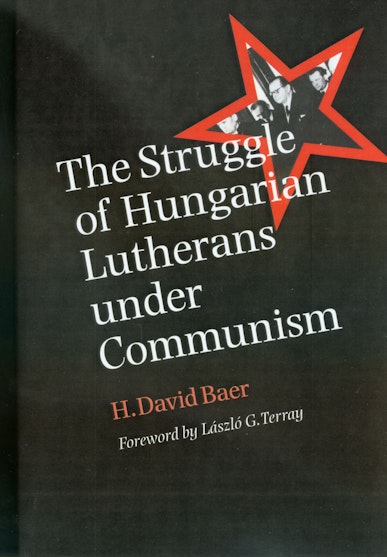
“There is no proper, objective history of Hungary’s Lutheran community during the state-socialist era. The author is a fine scholar and his mastery of the subject shines through every page. This unique book is a major contribution and fills a large gap in the literature.”--Zoltan Barany, University of Texas
“ . . . a striking tale of fidelity and infidelity, courage, compromise, confusion, and cowardice. David Baer has done all Christians a service by reminding us that the basic Christian confession, ‘Jesus is Lord,’ has a lot to do with public life. When the church remembers that, it can speak truth to power in ways that change history. When it forgets that saying ‘Jesus is Lord’ means that Caesar isn’t Lord, the church betrays itself and the society it is called to serve.” --George Weigel, senior fellow, Ethics and Public Policy Center, Washington, DC
“David Baer provides an accurate description, a thorough and profound analysis, and a rigorous evaluation of the Lutheran church’s response to the communist party-state’s repression, persecution, and control in Hungary. In his book we have a rare commodity, a first class theological investigation of the few moral options left to a church living under brutal conditions of communist dicatorship. Baer has a gift for splendid writing. He shows an admirable ability as a social ethicist and occasionally even as a church historian who understands the broad patterns of the way a church functions in the context of its society and culture. He writes critically yet not judgmentally; he shows empathy without adulation.” --Paul Mojzes, Rosemont College, PA, and Founder and co-editor, Religi
“The transition of the former communist Eastern European countries from a totalitarian and authoritarian political system into a democratic one, and from the socialist command economy to a market economy by the revolutionary changes in 1989-90 gave opportunity to pave the way for study and better understanding of the so-called ‘Second World.’ There were namely differences among the Eastern European countries because of the geopolitical context, their relationship to the powers of the world and because of their different degrees of political and economic development. Socialism had many faces in the various countries in their national context, in church-state or religion-state relationship, in tradition of the values, symbol system, and culture. We can speak about a certain type of ‘shock of complexity.’ No comprehensive general work on history of the socialist past and of the change in any Eastern European country or of the entire region has been written. Therefore it is of great importance that such contributions as the study of Helmut David Baer on life and struggle of the Lutheran Church in Hungary after the Second World War can provide a clear analysis of the years 1945-1990. His historical picture about the church is woven with special interest for the theological and moral issues drowning a lesson from the past for our time out of the example of Bishop Ordass as martyr. It was and it is a challenge namely for the political powers to change the closing words of the Lord’s Prayer, ‘Mine is the Kingdom and the power and the glory’ and create a totalitarian society, and it is also a challenge for the church to serve the worldly powers by an ‘accompanying liturgy.’” --Bishop em. Bela Harmati, Evangelical Lutheran Church, Hungary, Luthe