Rock Art of the Lower Pecos
Archaeology - Anthropology
8.5 x 11, 152 pp.
60 b&w photos., 5 color plates., 2 tables.
Pub Date: 11/05/2003
Texas A&M University Anthropology Series
  cloth $45.00
978-1-58544-259-1

Published by Texas A&M University Press
  THE CONSORTIUM

To Receive E-News


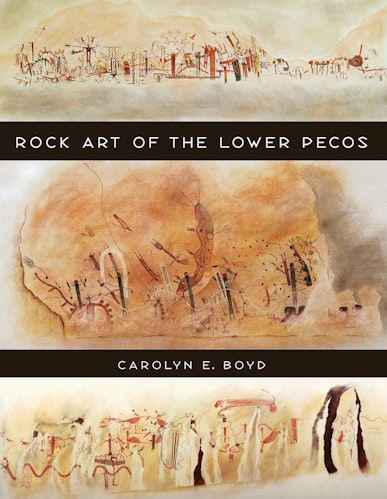
Rock Art of the Lower Pecos

By Carolyn E. Boyd

Four thousand years ago bands of hunter-gatherers lived in and traveled through the challenging terrain of what is now southwest Texas and northern Mexico. Today travelers to that land can view large art panels they left behind on the rock walls of Rattlesnake Canyon, White Shaman Cave, Panther Cave, Mystic Shelter, and Cedar Springs. Messages from a distant past, they are now interpreted for modern readers by artist-archaeologist Carolyn Boyd.

It has been thought that the meaning of this ancient art was lost with the artists who produced it. However, thanks to research breakthroughs, these elaborate rock paintings are again communicating a narrative that was inaccessible to humanity for millennia. In the gateway serpents, antlered shamans, and human-animal–cross forms pictured in these ancient murals, Boyd sees a way that ancient hunter-gatherer artists could express their belief systems, provide a mechanism for social and environmental adaptation, and act as agents in the social, economic, and ideological affairs of the community. She offers detailed information gleaned from the art regarding the nature of the lower Pecos cosmos, ritual practices involving the use of sacramental and medicinal plants, and hunter-gatherer lifeways.

Now, combining the tools of the ethnologist with the aesthetic sensibilities of an artist, Boyd demonstrates that prehistoric art is not beyond explanation. Images from the past contain a vast corpus of data—accessible through proven, scientific methods—that can enrich our understanding of human life in prehistory and, at the same time, expand our appreciation for the work of art in the present and the future.

Carolyn E. Boyd is the executive director and a founder of the Shumla School, an archaeological research and educational nonprofit corporation that has been formed to study the human use of materials, land, and art. She lives in the canyonlands of West Texas

What Readers Are Saying:

“This is a landmark volume on one of the most important bodies of rock art in the world. It is required reading for anyone interested in the Archaic prehistory of North America.”--David S. Whitley, author, The Art of the Shaman

“This is a landmark volume on one of the most important bodies of rock art in the world. It is required reading for anyone interested in the Archaic prehistory of North America.” --David S. Whitley, author, The Art of the Shaman

“New Interpretations and hypothesis concerning these mysterious yet evocative images left behind by hunter-gatherers of millennia ago fill the pages of this fascinating guide, which packed from cover to cover with the latest up-to-date findings, as well as an anthropological wealth of insightful ideas from a wide variety of experts and schools of thought concerning the uses of the art and the intentions of the ancient artists. Black-and-White as well as full color illustrations embellish this thoughtful and strongly recommended study.” --The Bookwatch

OF RELATED INTEREST

Osteology of Infants and Children
In Search of Maya Sea Traders
How War Began
Prehistory of Texas
Review Copy Request Form Desk Copy Request Form