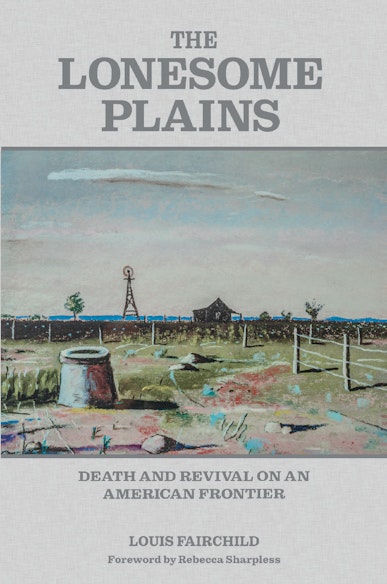
Loneliness pervaded the lives of pioneers on the American plains, including the empty expanses of West Texas. Most settlers lived in isolation broken only by occasional community gatherings such as funerals and religious revivals. In The Lonesome Plains, Louis Fairchild mines the letters and journals of West Texas settlers, as well as contemporary fiction and poetry, to record the emotions attending solitude and the ways people sought relief.
Hungering for neighborliness, people came together in times of misfortune—sickness, accident, and death—and at annual religious services. In fascinating detail, Fairchild describes the practices that grew up around these two focal points of social life. He recounts the building of coffins and preparation of a body for burial, the conflicting emotions of the pain of death and the hope of heaven, the funeral rite itself, the lost and lonely graves. And he tells the story of yearly outdoor revivals: the choice of the meeting site and construction of the arbor or other shelter, the provision of food, the music and emotionally-charged services, and tangential courting and mischief.
Loneliness is most recognized as a feature of life in the time of the early West Texas cattle industry, a period of sprawling cattle ranches and legendary cattle drives, roughly from 1867 to 1885. But Fairchild shows that it also characterized the lives of settlers who lived in West Texas from the beginning of permanent settlement of the Texas Panhandle (around 1876) through the population shift that occured around the turn of the century, as farmers and their families supplanted ranchers and their cattle.
Fairchild draws on primary materials of the early residents to give voice to the settlers themselves and skillfully weaves a moving picture of life in the open spaces of West Texas during the frontier-rural period of the late nineteenth and early twentieth centuries.
What Readers Are Saying:
“His interviews and careful combing of archives paint a picture that shows why settlers found loneliness to be the worst threat to life in a country where no comforts came easy.” --Amarillo Globe News
“The Lonesome Plains Death and Revival on an American Frontier written by Louis Fairchild published at Texas A&M University Press is an excellent account of how people separated by miles dealt with loneliness and the problems of being alone. The Chapters dealing with revivals make the book, worth ones time, effort and money. Just for this information, The Lonesome Plains should be in church libraries because nearly every church has roots in these large brush arbor meetings. Lonesome plains is a delightful book, giving insight to settlement on the plains. Get a copy of this fine book and learn how life was on the plains of early Texas. Donate a copy to your church library, you will really be glad you did.” --Mexia Daily News
“The Lonesome Plains is never flashy, but it’s powerful book that quietly and slowly penetrates deeply into the reader’s soul and brings vividly to life a bit of American history that isn’t so long gone.” --Washington Times
“This volume constitutes a landmark study, the reading of which is essential for any historical understanding of panhandle Texas.” --Choice
“Fairchild successfully captured the emotions and spirits of the early pioneers of West Texas and revealed how these courageous settlers coped with the pervasive loneliness of frontier society. Scholars will find this study a valuable contribution to Texas historiography, and the general public will appreciate the author’s vivid accounts of daily life on the Texas plains.” --East Texas Historical Association
“. . .lively and readable. . .a welcome addition ro undergraduate or graduate classes or the average reader who is interested in pioneer life in the Texas Panhandle.” --Jean A. Stuntz
“In allowing these early pioneers to tell their own story, Fairchild places them at the center of the settlement drama, and portrays them as people engaged in a desperate, lonely struggle who ultimately endured.” --Southwestern Historical Quarterly
“. . . an interesting and largely persuasive work of religious social history.” --Books & Culture
“Fairchild places them at the center of the settlement drama, and portrays them as people engaged in a desperate, lonely struggle who ultimately endured.” --Southwestern Historical Quarterly
“In the late 1800s the West Texas frontier was a wilderness fraught with both natural and emotional perils. The Lonesome Plains: Death and Revival on an American Frontier vividly portrays the dangers that awaited the pioneers. West Texas A&M University psychology professor Louis Fairchild has carefully examined a vast inventory of the letters and journals of the early settlers and crafted an engaging story to give them a voice.” --Panhandle-Plains Historical Review