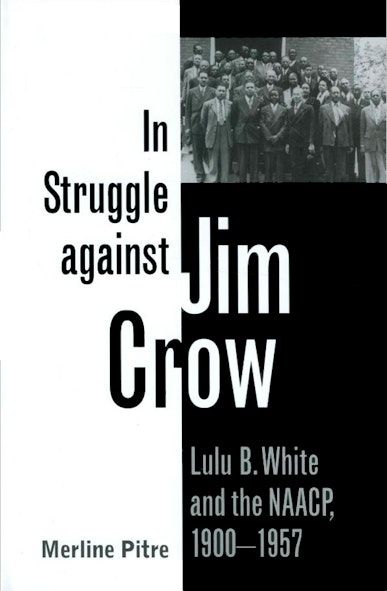
African American women have played significant roles in the ongoing struggle for freedom and equality, but relatively little is known about many of these leaders and activists.
Most accounts of the civil rights movement focus on male leaders and the organizations they led, leaving a dearth of information about the countless black women who were the backbone of the struggle in local communities across the country. At the local level women helped mold and shape the direction the movement would take. Lulu B. White was one of those women in the civil rights movement in Texas.
Executive secretary of the Houston branch of the NAACP and state director of branches, White was a significant force in the struggle against Jim Crow during the 1940s and 1950s. She was at the helm of the Houston chapter when the Supreme Court struck down the white primary in Smith v. Allbright, and she led the fight to get more blacks elected to public office, to gain economic parity for African Americans, and to integrate the University of Texas.
Author Merline Pitre places White in her proper perspective in Texas, Southern, African American, women's, and general American history; points to White's successes and achievements, as well as the problems and conflicts she faced in efforts to eradicate segregation; and looks at the strategies and techniques White used in her leadership roles.
Pitre effectively places White within the context of twentieth-century Houston and the civil rights movement that was gripping the state. In Struggle Against Jim Crow is pertinent to the understanding of race, gender, interest group politics, and social reform during this turbulent era.
What Readers Are Saying:
“The author is successful in meeting each of her stated objectives, especially in her discussion of Lulu White’s formative years. The importance of White’s childhood, education and friendships is artfully presented. Also noteworthy is the author’s candor in describing White’s hard-fought successes (e.g., her efforts to promote equal pay for public school teachers, to work for the abolition of white primaries, to promote desegregation of the University of Texas, and to expand the membership of the NAACP in Houston) and her numerous setbacks (e.g., the failed attempt at establishing the FEPC, the unsuccessful attempts to improve wages and collective bargaining, and the ongoing political and personality conflicts with the African American community and the Houston chapter of the NAACP).
“ . . . [White] certainly comes across as a forceful, effective female voice in the struggle for racial equality in Texas. The book certainly adds to our knowledge of and appreciation for civil rights activity at the local level. . . . The best feature of the work is the effective way the author meshes national events together with the work of Lulu White in Houston.”--Michael R. Heintze, Clemson University, and author of Private Black Colleges in Texas, 1865–1954
“In Struggle against Jim Crow is an important contribution to the growing library of books revealing the strategic interventions of local black women in the modern civil rights movement. Merline Pitre’s thoughtful and well-researched biography of Lulu White enriches our understanding of how a strong and committed black Texas woman supported national and local community organizations and courageously challenged practices and ideologies of white supremacy.”—Darlene Clark Hine, John A. Hannah Professor of History, Michigan State University, coauthor of A Shining Thread of Hope: The History of Black Women in America --John Bracey, co-editor, The Papers of the NAACP
“Of the many untold stories in the history of African Americans, two of the most important are the activities of the numerous chapters of the NAACP and the significant roles played by Black women in the struggles for civil rights and black liberation. Professor Merline Pitre has done a great service in unearthing and presenting to us the story of Lulu B. White, an activist and leader of considerable skill, who was a major force in the NAACP chapter in Houston, Texas. I knew her name; now we all know the magnitude of her accomplishments. A great study, a great life.” --John Bracey, co-editor, The Papers of the NAACP
“Native Texan, charismatic activist, organizer, and strategist in the NAACP’s Houston and Texas branches, Lulu B. White emerged as a leader in the Age of Jim Crow. She spearheaded legal and direct action battles to desegregate electoral politics, higher education, and public accommodations. White’s engaging story widens our knowledge of pre-1954, largely understudied racial activists, including the `countless black women who were the backbone of the civil rights struggle in local communities across the country.” Professor Pitre’s important book contributes to scholarship and teaching in African American history as well as women’s studies.” --Raymond Gavins, professor of Afro-American & Southern History, Duke Unive
“ . . . The story of Lulu White is local history at its best and a model of contextual biography.” --Choice
“I recommend this fine study of an important but neglected chapter of the early civil rights movement.” --Steven A. Reich
“Merline Pitre’s work gives voices and faces to this generation of bridge women who defined the quest for equality for the post-Brown era.” --American Historical Review