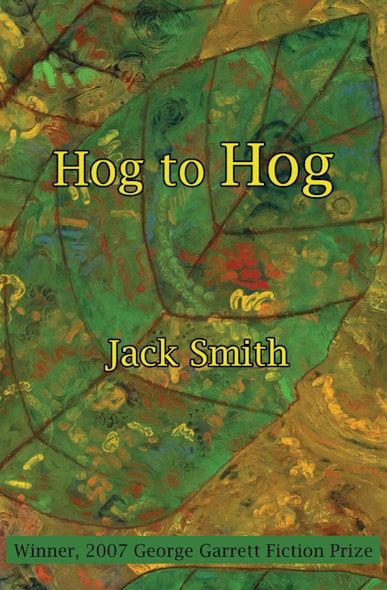
A dark comedy written in rollicking prose, Hog to Hog deals with excessive development in a relatively pristine Midwestern rural area. The spoils of misadventure go to the top polluters, like Dick Columbus, who makes money for the state’s coffers with his Wheeleroo!, an ATV mega event that runs roughshod over the local nature sanctuary. Columbus wins a seat in the state Senate. Bernie Sapp, the novel’s protagonist, lacks political savvy and power and ends up in one of Columbus’s pet projects, the newly constructed prison. With a culture based on plunder and socio-economic injustice, the ordinary man’s American Dream turns into the American Nightmare.
JACK SMITH has published fiction in such literary journals as The Southern Review, The Texas Review, North American Review, X-Connect, Happy, In Posse Review, Southern Ocean Review, and B&A: New Fiction. His reviews have appeared in Missouri Review, Texas Review, Georgia Review, Pleiades, X-Connect, RE:AL, and Environment magazine. He also has written a number of articles for Novel & Short Story Writer’s Market and The Writer and co-authored the nonfiction work Killing Me Softly (Monthly Review Press, 2002). He is founder and co-editor of the Green Hills Literary Lantern, an online journal, published by Truman State University.
What Readers Are Saying:
“Jack Smith’s stunning first novel, Hog to Hog, proves William Styron’s thesis that ‘only a great satirist can tackle the world’s problems and articulate them.’ The pace is feverish, with non-stop action revealing new heights of national folly, greed, and excess. Bernie Sapp, Smith’s protagonist, is by turn a fearful, angry, arrogant, acquisitive, horny, and touching Everyman as he scrambles avidly for his slice of the pie. Smith’s prose is crisp and acerbic, his themes reminiscent of Heller, Southern and Nathaniel West: surely this is what black humor is all about.” --Geoffrey Clark
“Boisterous and compelling, Hog to Hog is often a funhouse mirror reflecting American materialism, greed, and crassness. Jack Smith’s spot-on dialogue will make you laugh; this award-wining tale, the taller it grows, will convince you to treasure it as good old satire.” --Mark Wisniewski