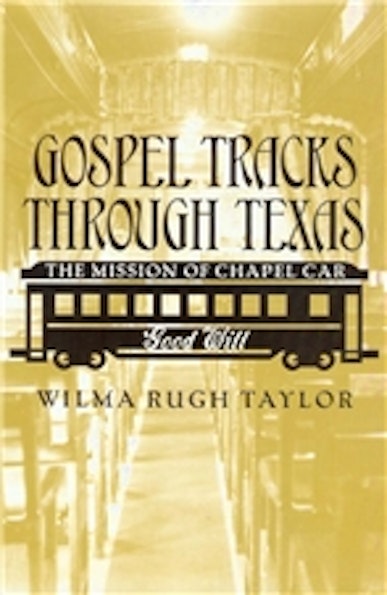
In 1895 a different kind of railroad car rolled into Texas, bringing the “good news” of the evangelical Gospel to transient railroad workers and far-flung communities alike. A ministry to railroad men and their families lay at the heart of chapel car work, which over a period of fifty years saw thirteen rail chapel cars minister to thousands of towns, mainly west of the Mississippi. Author Wilma Rugh Taylor’s portrayal of this ministry for the one car, Good Will, which served Texas, provides a view of life in towns such as Denison, Texline, Marshall, San Antonio, Laredo, Abilene, and Dalhart. The railroads that carried the Texas chapel car included the Texas & Pacific; the Missouri, Kansas & Topeka; the Southern Pacific; the International & Great Northern; and the Mexican International. Taylor writes about the travels of Good Will with fondness and an eye for detail. She describes the car itself (its living area was just nine by eighteen feet with a decorative rococo stencil on the ceiling), the missionary couples who traveled in it, the services that were held. She considers the philanthropists who supported the mobile chapel and the guilt and other motives that moved them. She looks at the issues the chapel car faced as it rolled into town: temperance, turbulent religious rivalries, racism and immigration, the role of Masons and other lodges in rural society, and even the devastating Great Storm of 1900 in Galveston. A novel window onto Texas and railroad history, this book tells a warmly human story set on a larger stage of charitable works, evangelical fervor, and social change. A window into Texas and railroad history, this book recounts the ministry of a chapel car that brought the “good news” to railroad workers and rural Texas towns beginning in 1895. Besides describing the car itself and the missionaries who traveled in it, Taylor considers issues it faced such as temperance, religious rivalries, racism and immigration, and even the Great Storm of 1900 in Galveston.
Wilma Rugh Taylor, an author, historian, and former journalism teacher, is an active member of the American Baptist Historical Society and National Railroad Historical Association. With her husband, she is the co-author of a previous book on chapel cars nationally, This Train Is Bound for Glory: The Story of America’s Chapel Cars. Their research encouraged the restoration of chapel car Grace, which is currently in progress at the Green Lake Conference Center, Green Lake, Wisconsin.
What Readers Are Saying:
“This is a fine work of social, cultural and religious history. Taylor’s style is almost cinematographic in that it is conceptualized in a visual way. It reminds me of the novel Lonesome Dove in the way McMurtry slingshots between locations, introducing characters and the suggestions of characters that will enter the story at some later time. I also like the way well known historical figures are set into this largely unknown theme linking evangelism and transportation. It’s a powerful narrative and great fun to read.”--Paul C. Stone, University of Minnesota
“Gospel Tracks through Texas offers an exceptionally well-crafted examination of the nearly forgotten railroad chapel car phenomenon. This study of the Chapel Car Good Will is wonderful church history, railroad history, social history, and Texas history.”-H. Roger Grant, Centennial Professor of History, Clemson University
“. . .engaging and interesting. I was impressed by the detail and coverage of so many places and events. . . provides an intimate look at a lifestyle/belief system about which little has been written. Gospel Tracks through Texas has been carefully researched, and written with much evident compassion.”-Richard Francavigla, Professor of History and Geography, University of Texas
“Gospel Tracks through Texas: The Mission of Chapel Car Good Will is a fascinating read of innovative mission efforts in post Civil War Texas. Northern Baptist missionaries in cooperation with the Baptist General Convention of Texas faced the challenges of frontier ministry as they followed the expansion of railroads to establish churches in what the author calls “hell on wheels” towns along the routes. As they do so they encounter both tragedy and triumph as they work in the midst of tensions around race immigration and natural disasters. A satisfying account for those interested in home mission.”-A. Roy Medley, General Secretary, American Baptist Churches in the U.S.A.
“The author complements the Good Will chapel car story with fascinating detail about Baptist concerns at that time in Texas, many state and railroad facts including the Galveston storm, and an unusual glimpse of the war in Cuba.”-Baptist Standard
“…an impressive picture of the economic, racial, and religious factors at work in rural Texas at the turn of the century.” --East Texas Historical Association
“…an important introduction to students interested in rural Texas, railroad life, Baptist missions, and denominational histories.”-The Journal of Southern History
“A must read for anyone seeking to understand this pivotal time in Texas Baptist history.”-Baptist History and Heritage